

When Did Us States Print Their Own Money
The history of the Usa dollar began with moves by the Founding Fathers of the United states of America to plant a national currency based on the Spanish argent dollar, which had been in use in the North American colonies of the United Kingdom for over 100 years prior to the United States Announcement of Independence. The new Congress'south Coinage Human action of 1792 established the United States dollar as the country's standard unit of money, creating the United states Mint tasked with producing and circulating coinage. Initially defined under a bimetallic standard in terms of a stock-still quantity of silver or gold, it formally adopted the gold standard in 1900, and finally eliminated all links to gilt in 1971.
Since the founding of the Federal Reserve Organization in 1913 as the cardinal depository financial institution of the United States, the dollar has been primarily issued in the form of Federal Reserve Notes. The Us dollar is the world's primary reserve currency held by governments worldwide for use in international merchandise.
Origins: the Spanish dollar [edit]
The United states Mint commenced production of the The states dollar in 1792 as a local version of the popular Spanish dollar or slice of eight produced in Spanish America and widely circulated throughout the Americas from the 16th to the 19th centuries. Fabricated with similar silver content to its counterparts minted in Mexico and Republic of peru, the Spanish, U.S. and Mexican silverish dollars all circulated side by side in the The states, and the Spanish dollar and Mexican peso remained legal tender until the Coinage Act of 1857.
Continental Currency [edit]
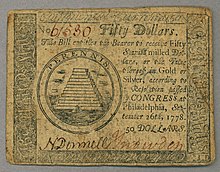
Later on the American Revolutionary War began in 1775, the Continental Congress began issuing paper money known as Continental currency, or Continentals. Continental currency was denominated in dollars from $ ane⁄6 to $eighty, including many odd denominations in between. During the Revolution, Congress issued $241,552,780 in Continental currency.[1] By the end of 1778, this Continental currency retained but between 1⁄5 to 1⁄7 of its original face value. Past 1780, Continental bills – or Continentals – were worth merely 1⁄40 of their face value. Congress tried to reform the currency by removing the sometime bills from circulation and issuing new ones, but this met with little-to-no success. By May 1781, Continentals had get so worthless they ceased to circulate as money. Benjamin Franklin noted that the depreciation of the currency had, in upshot, acted as a tax to pay for the war.[2] In the 1790s, later on the ratification of the United states Constitution, Continentals could be exchanged for treasury bonds at i% of face value.[1]
Congress appointed Robert Morris to exist Superintendent of Finance of the United States following the collapse of the Continental currency. In 1782, Morris advocated the creation of the commencement fiscal institution chartered by the United States. The Bank of North America was funded in role by bullion coin, loaned to the Usa by France. Morris helped finance the final stages of the war by issuing promissory notes in his name, backed by his own money. The Bank of Northward America also issued notes convertible into golden or silver.[3]
Runaway inflation and the collapse of the Continental currency prompted delegates at the Constitutional Convention in Philadelphia in 1787 to include the gold and silver clause in the United States Constitution, preventing individual States from issuing their own bills of credit. Article One states they were prohibited to "make any Thing but golden and silver Money a Tender in Payment of Debts."[4] Some people use this clause to argue that federal paper coin is unconstitutional, though very few constitutional scholars agree that position.[5] [6]
Coinage Act of 1792 [edit]
On July half-dozen, 1785, the Continental Congress of the United States authorized the issuance of a new currency, the US dollar.[7] The give-and-take dollar is derived from Low Saxon cognate of the High german Thaler; the term had already been in common usage since the colonial period when it referred to eight-real coin (Spanish dollar) or the "Castilian milled dollar" issued by the Spanish from New Spain and used throughout the rest of the Americas. The Spanish dollar was the most unremarkably circulated and readily available currency used by common Americans and was valued for its high silver content.
Later on, the American administration of President George Washington turned its attention to monetary bug again in the early 1790s, under the leadership of Alexander Hamilton, the Secretary of the Treasury at the time. Congress acted on Hamilton's recommendations, with the Coinage Act of 1792 that established the dollar as the basic unit of measurement of account for the Us.
The The states Mint was created by Congress following the passing of the Coinage Act..[8] It was primarily tasked with producing and circulating coinage. The first Mint building was in Philadelphia, and then the capital of the The states. The Mint was originally placed within the Department of State, until the Coinage Human activity of 1873 when it became office of the Department of the Treasury (in 1981 it was placed under the auspices of the Treasurer of the Us). The Mint had the potency to convert whatever precious metals into standard coinage for anyone's account with no seigniorage charge across refining costs.
19th century [edit]
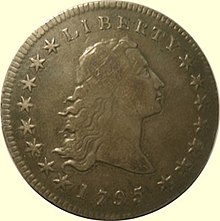
A 1795 Flowing Hair Dollar


ii dollars, first November 1862
In the early on 19th century, the intrinsic value of aureate coins rose relative to their nominal equivalent in silver coins, resulting in the removal from commerce of nearly all gold coins, and their subsequent private melting. Therefore, in the Coinage Act of 1834, the fifteen:1 ratio of silver to gold was changed to a sixteen:1 ratio by reducing the weight of the nation's gilded coinage. This created a new U.S. dollar that was backed by 1.l grams (23.22 grains) of gilded. However, the previous dollar had been represented by i.60 g (24.75 grains) of gold. The result of this revaluation, which was the first devaluation of the U.S. dollar, was that the value in gilded of the dollar was reduced by 6%. Moreover, for a time, both gold and silver coins were useful in commerce.
In 1853, the weights of U.Due south. silver coins (except the dollar itself, which was rarely used) were reduced. This had the effect of placing the nation effectively (although not officially) on the gold standard. The retained weight in the dollar coin was a nod to bimetallism, although information technology had the result of further driving the silvery dollar coin from commerce. Foreign coins, including the Spanish dollar, were as well widely used[ix] as legal tender, until 1857.
With the enactment of the National Banking Act of 1863—during the American Civil State of war—and its later on versions that taxed states' bonds and currency out of being, the dollar became the sole currency of the United States and remains so today.
During the 19th century the dollar was less accepted effectually the earth than the British pound. Nellie Bly carried Bank of England notes on her 1889–1890 trip around the globe in 72 days; she also brought some dollars, Bly wrote, "to use at dissimilar ports every bit a test to see if American money was known exterior of America". Traveling east from New York, she did not run into American money until she found $20 gold pieces used as jewelry in Colombo; there Bly found that every bit currency dollars were accepted at a threescore% disbelieve.[ten]
In 1878, the Bland–Allison Human action was enacted to provide for freer coinage of silver. This deed required the government to purchase between $2 meg and $4 meg worth of silver bullion each month at market prices and to coin information technology into silver dollars. This was, in issue, a subsidy for politically influential silvery producers.
The discovery of large silver deposits in the Western U.s.a. in the late 19th century created a political controversy. Due to the large influx of silver, the intrinsic value of the silver in the nation's coinage dropped precipitously. On 1 side were agrestal interests such as the Greenback Party that wanted to retain the bimetallic standard in order to inflate the dollar, which would allow farmers to more hands repay their debts. On the other side were Eastern banking and commercial interests, who advocated audio money and a switch to the gold standard. This upshot split the Democratic Party in 1896. Information technology led to the famous Cantankerous of Gold speech given by William Jennings Bryan, and may have inspired many of the themes in The Wizard of Oz. Despite the controversy, the status of silvery was slowly macerated through a series of legislative changes from 1873 to 1900, when a gold standard was formally adopted. The aureate standard survived, with several modifications, until 1971.
Gilt standard [edit]
Annotation: all references to 'ounce' in this department are to the troy ounce as used for precious metals, rather than to the (smaller) avoirdupois ounce used in the Us customary units organization for other goods.

A gold-standard 1928 one-dollar nib. It is identified as a "United States Notation" rather than a Federal Reserve annotation and by the words "Will Pay to the Bearer on Demand", which do not announced on today's currency. This clause became obsolete in 1933 but remained on new notes for 30 years thereafter.
Bimetallism persisted until March 14, 1900, with the passage of the Gold Standard Act,[11] which provided that:
... the dollar consisting of twenty-v and eight-tenths grains of aureate 9-tenths fine, as established past department thirty-five hundred and eleven of the Revised Statutes of the U.s.a., shall be the standard unit of measurement of value, and all forms of money issued or coined by the U.s. shall be maintained at a parity of value with this standard ...
Thus the The states moved to a aureate standard, making both gold and silvery the legal-tender coinage of the United states, and guaranteed the dollar equally convertible to 25.eight grains (i.672 grams, 0.05375 troy ounces) of golden, or a little over $eighteen.sixty per ounce.
The gold standard was suspended twice during World War I, once fully and then for foreign exchange. At the onset of the war, U.S. corporations had large debts payable to European entities who began liquidating their debts in aureate. With debts to Europe falling due, the dollar to (British) pound sterling exchange charge per unit reached as high every bit $6.75:£1,[ when? ] far above the nominal (aureate) parity of 4.8665:1. This caused big gilt outflows until July 31, 1914, when the New York Stock Exchange closed and the gold standard was temporarily suspended. In order to defend the exchange rate of the dollar, the US Treasury Section authorized state and nationally chartered banks to effect emergency currency under the Aldrich-Vreeland Deed, and the newly created Federal Reserve organized a fund to clinch debts to foreign creditors. These efforts were largely successful, and the Aldrich-Vreeland notes were retired starting in November and the gold standard was restored when the New York Stock Exchange re-opened in December 1914.[12]
For as long as the United states of america remained neutral in the war, it remained the only country to maintain its aureate standard, doing then without restriction on import or consign of gold from 1915 to 1917. When the United States became a argumentative in the state of war, President Wilson banned gold export, thereby suspending the gold standard for foreign exchange. Later on the state of war, European countries slowly returned to their gold standards, though in somewhat altered grade.[12] [13]
During the Nifty Depression, every major currency abased the gilded standard. Amid the earliest, the Bank of England abandoned the gold standard in 1931 as speculators demanded golden in commutation for currency notes or in settlement of debts, threatening the solvency of the British budgetary system. This pattern repeated throughout Europe and N America. In the United states, the Federal Reserve was forced to enhance involvement rates in guild to protect the gold standard for the United states of america dollar, worsening already severe domestic economical pressures. After bank runs became more pronounced in early 1933, people began to hoard gold coins as distrust for banks led to distrust for paper money, worsening deflation and depleting aureate reserves.[12] [13]
The Gilt Reserve Act [edit]
In early on 1933, in order to fight severe deflation, Congress and President Roosevelt implemented a serial of Acts of Congress and Executive Orders which suspended the gold standard except for foreign commutation, revoked gold as universal legal tender for debts, and banned private ownership of significant amounts of gold coin. These acts included Executive Gild 6073, the Emergency Banking Act, Executive Society 6102, Executive Society 6111, the Agronomical Adjustment Deed, 1933 Banking Deed, the gold clause resolution, and afterwards the Gold Reserve Human activity.[12] These deportment were upheld by the U.Southward. Supreme Courtroom in the "Gold Clause Cases" in 1935.[14]
For strange exchange purposes, the set $20.67 per ounce value of the dollar was lifted,[ when? ] allowing the dollar to float freely in foreign exchange markets with no gear up value in gold. This was terminated after one year. Roosevelt attempted offset to restabilize falling prices with the Agricultural Adjustment Human action; still, this did not prove pop, so instead the next politically pop option was to devalue the dollar on strange substitution markets. Under the Gold Reserve Human action the price of gold was stock-still at $35 per ounce, making the dollar more attractive for strange buyers (and making strange currencies more expensive for those holding dollars). This change led to more conversion of aureate into dollars, allowing the U.Southward. to effectively corner the world gilt market.[xv] [16]
The pause of the golden standard was considered temporary past many in markets and in the government at the time, but restoring the standard was considered a low priority to dealing with other issues.[12] [xv]
Nether the mail service-World War Ii Bretton Forest system, all other currencies were valued in terms of U.South. dollars and were thus indirectly linked to the gold standard. The need for the U.South. regime to maintain both a $35 per troy ounce (112.53cents/gram) market price of gold and as well the conversion to foreign currencies caused economic and trade pressures. By the early on 1960s, compensation for these pressures started to become besides complicated to manage.
In March 1968, the effort to control the private market place price of gold was abandoned. A two-tier arrangement began. In this system all fundamental-depository financial institution transactions in gold were insulated from the costless market place price. Fundamental banks would trade gilt among themselves at $35/ounce (112.53¢/m) but would not trade with the individual market. The individual market could trade at the equilibrium market price and there would be no official intervention. The cost immediately jumped to $43/ounce (138.25¢/g). The price of gold touched briefly back at $35/ounce (112.53¢/g) virtually the cease of 1969 before beginning a steady toll increment. This gold price increase turned steep through 1972 and hitting a high that yr of over $70/ounce (2.25$/grand). By that fourth dimension floating commutation rates had as well begun to emerge, which indicated the de facto dissolution of the Bretton Forest system. The 2-tier system was abandoned in November 1973. By so the price of golden had reached $100/ounce (3.22$/g).
In the early 1970s, inflation caused by ascent prices for imported commodities, particularly oil, and spending on the Vietnam War that was not counteracted by cuts in other government expenditures, combined with a trade arrears to create a situation in which the dollar was worth less than the gilded used to back it.[ description needed ]
In 1971, President Richard Nixon unilaterally ordered the cancellation of the direct convertibility of the The states dollar to gold. This human action was known as the Nixon Shock.
U.Due south. dollar value vs. gold value [edit]
The sudden spring in the toll of gilded subsequently the demise of the Bretton Forest accords was a event of the significant prior debasement of the US dollar due to excessive inflation of the monetary supply via central banking company (Federal Reserve) coordinated fractional reserve banking under the Bretton Woods partial gold standard. In the absenteeism of an international mechanism tying the dollar to gilded via fixed exchange rates, the dollar became a pure fiat currency and as such fell to its gratis market exchange price versus gold. Consequently, the price of gold rose from $35/ounce (ane.125 $/g) in 1969 to almost $500 (29 $/g) in 1980.
Before long later on the dollar cost of gilded started its rise in the early 1970s, the price of other commodities such as oil also began to ascent. While commodity prices became more than volatile, the boilerplate toll of oil as expressed in aureate (or vice versa) remained much the same in the 1990s as information technology had been in the 1960s, 1970s and 1980s.
Note Issuance [edit]
Silver certificates [edit]
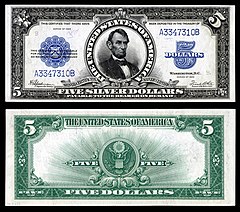
"Five Silver Dollars" of Series 1923
United states argent certificates were a type of representative money printed from 1878 to 1964 in the The states as part of its circulation of paper currency.[17] They were produced in response to silver agitation past citizens who were angered by the Fourth Coinage Deed, and were used alongside the gilt-based dollar notes. The argent certificates were initially redeemable in the same confront value of silver dollar coins, and afterwards in raw silver bullion.
Since the early 1920s, silver certificates were issued in $one, $v, and $ten denominations. In the 1928 series, just $i silverish certificates were produced. Fives and tens of this fourth dimension were mainly Federal Reserve notes, which were backed by and redeemable in gilt. In 1933, Congress passed the Agricultural Adjustment Human action which included a clause allowing for the pumping of silvery into the marketplace to supervene upon the gold. A new 1933 series of $10 argent certificate was printed and released, but not many were released into apportionment.
In 1934, a law was passed in Congress that changed the obligation on Silver Certificates and so equally to denote the current location of the silverish.
The last government regulation regarding the silver standard was in 1963, when President John F. Kennedy issued Executive Order 11110, delegating to the Treasury Secretarial assistant his authorisation to authorize the United states of america Section of Treasury to effect argent certificates for whatever silver held by the U.Southward. Government in excess of that not already bankroll issued certificates. This was necessary because of Kennedy'south signing of Public Law 88-36 on the same 24-hour interval, 1 of the effects of which was a repeal of the Silver Purchase Deed of 1934-this human activity had authorized the Treasury Secretarial assistant to buy silver bullion and issue silverish certificates against it. Silver certificates continued to be issued for a short menstruum of fourth dimension in the $1 denomination, but were discontinued in late 1963.
U.s.a. Notes [edit]
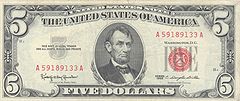
$5 United States Annotation of Serial 1963.
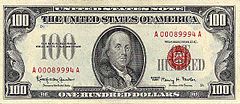
$100 United states Notation of Series 1966.
A United States Note, also known as a Legal Tender Notation, was a blazon of paper coin that was issued from 1862 to 1971 in the U.S. Having been electric current for over 100 years, they were issued for longer than any other course of U.S. paper coin. They were known popularly as "greenbacks" in their day, a name inherited from the Demand Notes that they replaced in 1862.
While issuance of U.s. Notes ended in January 1971, existing United States Notes are still valid currency in the United States today, though rarely seen in apportionment.
Both United States Notes and Federal Reserve Notes are parts of the national currency of the Us, and both have been legal tender since the aureate recall of 1933. Both have been used in circulation equally money in the same manner. However, the issuing dominance for them came from dissimilar statutes.[18] United States Notes were created equally fiat currency, in that the government has never categorically guaranteed to redeem them for precious metal - even though at times, such every bit later on the specie resumption of 1879, federal officials were authorized to do so if requested.
The departure between a The states Note and a Federal Reserve Note is that a United States Annotation represented a "bill of credit" and was inserted by the Treasury direct into circulation free of interest. Federal Reserve Notes are backed by debt purchased by the Federal Reserve, and thus generate seigniorage for the Federal Reserve System, which serves as a lending intermediary between the Treasury and the public.
Federal Reserve Notes [edit]
Congress continued to issue paper money later on the Ceremonious State of war, the well-nigh important of which was the Federal Reserve Note that was authorized by the Federal Reserve Deed of 1913. Since the discontinuation of all other types of notes (Aureate Certificates in 1933, Silvery Certificates in 1963, and U.s.a. Notes in 1971), US dollar notes have since been issued exclusively every bit Federal Reserve Notes.
Use as international reserve currency [edit]
History [edit]
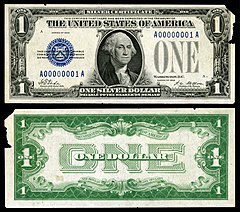
First small-sized $one beak which was issued in 1928 every bit a silvery certificate
Globe War 2 devastated European and Asian economies while leaving the United States' economic system relatively unharmed.[19] As European governments exhausted their aureate reserves and borrowed to pay the U.s.a. for war material, the The states accumulated large gold reserves. This combination gave the The states significant political and economic power following the war.[20]
The Bretton Woods agreement codified this economical dominance of the dollar afterwards the state of war. In 1944, Allied nations sought to create an international monetary order that sustained the global economic system and prevented the economic malaise that followed the Outset World War. The Bretton Forest understanding laid the foundations for an international monetary order that created rules and expectations for the international economy. It created the International monetary fund (International monetary fund), the predecessor of the World Bank, and an international monetary system based on fixed exchange rates. Information technology valued the dollar at $35 per ounce of aureate and the remaining signatories pegged their respective currency relative to the dollar, leading some economists to argue that Bretton Woods "dethroned"[21] gold as the default nugget.[22]
While Bretton Woods institutionalized the dollar's importance following the war, Europe and Asia faced dollar shortages. The international customs needed dollars to finance imports from the United States to rebuild what was lost in the war.[23] In 1948 Congress passed the European Recovery Program - generally known as the Marshall Plan – giving dollars to European countries to purchase imports needed to rebuild their economies. The plan helped European countries past providing them dollars to purchase the imports needed to produce exports, somewhen assuasive the countries to export enough of their ain appurtenances to obtain the dollars necessary to sustain their economies without reliance on any Marshall-like program. At the same fourth dimension, Joseph Dodge worked with Japanese officials and Congress to pass the Contrivance Program in 1949, which worked similarly to the Marshall Program, but for Japan rather than Europe.[22]
The Marshall and Dodge plans' successes have brought new challenges to the U.S. dollar. In 1959, dollars in circulation around the world exceeded U.S. gold reserves, which became vulnerable to the equivalent of a bank run. In 1960, Yale economist Robert Triffin described the problem to Congress: either the dollar was not freely bachelor and other countries could non beget to import American appurtenances, or the dollar was freely bachelor but conviction that the dollar could be converted to gold would wane.[24]
Eventually, the United States chose to devalue the dollar. During the early 1960s American officials largely prevented the conversion of dollars to gold with a series of "gentlemanly" agreements and other policies – which included the London Gold Pool - but these actions were not sustainable; the danger of a run on U.Southward. gilded reserves was too high.[25] With Nixon's ballot in 1968, American officials became increasingly concerned until Nixon finally issued Executive Order 11615 in August 1971, ending the direct convertibility of dollars to gold. He said, "We must protect the position of the American dollar as colonnade of monetary stability around the earth ... I am adamant that the American dollar must never over again be earnest in the hands of the international speculators."[26] This became known as the Nixon Shock and marked the dollar's transition from the gold standard to a fiat currency.
Bear upon [edit]
The United States enjoys some benefits considering the dollar serves as the international reserve currency. The United States is less probable to face a remainder of payments crunch.
Fiat standard [edit]
Today, like the currency of most nations, the dollar is fiat money, unbacked by any physical asset. A holder of a federal reserve annotation has no correct to demand an asset such as gilded or silver from the government in commutation for a notation.[27] Consequently, some proponents of the intrinsic theory of value believe that the nigh-cipher marginal price of production of the current fiat dollar detracts from its attractiveness as a medium of commutation and store of value considering a fiat currency without a marginal cost of product is easier to debase via overproduction and the subsequent inflation of the money supply.
In 1963, the words "PAYABLE TO THE BEARER ON DEMAND" were removed from all newly issued Federal Reserve notes. Then, in 1968, redemption of pre-1963 Federal Reserve notes for gold or silver officially concluded. The Coinage Act of 1965 removed all silvery from quarters and dimes, which were 90% silverish prior to the human action. Even so, at that place was a provision in the deed allowing some coins to contain a xl% silver consistency, such every bit the Kennedy Half Dollar. After, even this provision was removed, with the last circulating silvery-content halves minted in 1969. All coins previously minted in silver for general circulation are now clad. During 1982, the composition of the cent was inverse from copper to zinc with a sparse copper coating. The content of the nickel has non changed since 1866 (except for 1942-1945 when silverish and other metals were used to preserve nickel for war uses).[28] Silver and gold coins are produced by the U.S. government, but only as non-circulating commemorative pieces or in sets for collectors.
All circulating notes, issued from 1861 to present, will exist honored by the government at face value every bit legal tender. This means that the federal government volition accept old notes every bit payments for debts owed to the federal government (taxes and fees), or commutation old notes for new ones, but will not redeem notes for gold or argent, even if the note states that it may be thus redeemed. Some bills may have a premium to collectors.[ commendation needed ]
The only exception to this rule is the $10,000 gold document of Serial 1900, a number of which were inadvertently released to the public considering of a fire in 1935. This prepare is not considered to exist "in circulation" and, in fact, is stolen property. However, the government canceled these banknotes and removed them from official records. Their value, relevant only to collectors, is approximately one one thousand US dollars.[29]
Co-ordinate to the Federal Reserve Bank of New York, in that location is $i.2 trillion in total U.s.a. currency in worldwide apportionment every bit of July 2013.[30]
Color and design [edit]
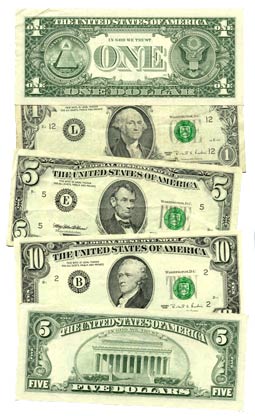
U.S. Federal Reserve notes in the mid-1990s
The federal government began issuing newspaper currency during the American Civil War. As photographic engineering of the day could not reproduce color, it was decided the back of the bills would be printed in a colour other than black. Considering the color light-green was seen as a symbol of stability, it was selected. These were known as "greenbacks" for their colour and started a tradition of the The states' printing the back of its money in green. The author of that invention was chemist Christopher Der-Seropian.[31] In dissimilarity to the currency notes of many other countries, Federal Reserve notes of varying denominations are the same colors: predominantly blackness ink with green highlights on the front, and predominantly green ink on the back. Federal Reserve notes were printed in the aforementioned colors for most of the 20th century, although older bills called "silverish certificates" had a blueish seal and serial numbers on the front, and "U.s. notes" had a red seal and series numbers on the forepart.

In 1928, sizing of the bills was standardized (involving a 25% reduction in their current sizes, compared to the older, larger notes nicknamed "horse blankets").[32] The Secretary of the Treasury directed a reduction in newspaper currency from a 7+ 7⁄16 inch past 3+ 9⁄64 inch size to a 6+ v⁄16 inch past 2+ 11⁄16 inch (half-dozen.31' ×2.69') size, which allowed the Treasury Department to produce 12 notes per 16+ 1⁄4 inch past 13+ 1⁄four inch sheet of newspaper that previously would yield 8 notes at the old size.[33] Modern U.S. currency, regardless of denomination, is 2.61 inches ( 66.3 mm) wide, 6.14 inches ( 156 mm) long, and 0.0043 inches ( 0.109 mm) thick. A single bill weighs about fifteen and a half grains (one gram) and costs approximately 4.2 cents for the Bureau of Engraving and Printing to produce.
Microprinting and security threads were introduced in the 1991 currency series.
Another series started in 1996 with the $100 note, calculation the post-obit changes:
- A larger portrait, moved off-middle to create more space to contain a watermark.
- The watermark to the right of the portrait depicting the aforementioned historical figure as the portrait. The watermark can be seen just when held upward to the light (and had long been a standard feature of all other major currencies).
- A security thread that will glow pink when exposed to ultraviolet light in a dark environment.[34] The thread is in a unique position on each denomination.
- Color-shifting ink that changes from dark-green to black when viewed from different angles. This characteristic appears in the numeral on the lower right-mitt corner of the bill front.
- Microprinting in the numeral in the note'southward lower left-hand corner and on Benjamin Franklin's coat.
- Concentric fine-line press in the groundwork of the portrait and on the back of the note. This type of printing is difficult to copy well.
- The value of the currency written in 14pt Arial font on the back for those with sight disabilities.
- Other features for auto authentication and processing of the currency.
Annual releases of the 1996 series followed. The $50 note followed on June 12, 1997, and introduced a large dark numeral with a light background on the back of the annotation to brand it easier for people to place the denomination.[35] The $twenty note in 1998 introduced a new machine-readable capability to aid scanning devices. The security thread glows green nether ultraviolet lite, and "United states of america TWENTY" and a flag are printed on the thread, while the numeral "20" is printed within the star field of the flag. The microprinting is in the lower left ornamentation of the portrait and in the lower left corner of the annotation front. As of 1998[update], the $20 note was the well-nigh frequently counterfeited note in the United States. The new design of the $v and $x notes were released in 2000.
In 2003, the Treasury appear that it would innovate new colors into the $20 bill, the first U.S. currency since 1905 (not counting the 1934 gold certificates) to have colors other than green or black. The motion was intended primarily to reduce counterfeiting, rather than to increase visual differentiation between denominations. The main colors of all denominations, including the new $20 and $50, remain light-green and blackness; the other colors are present only in subtle shades in secondary pattern elements. This contrasts with notes of the euro, Australian dollar, and most other currencies, where strong colors are used to distinguish each denomination from the other.
The new $twenty bills entered circulation on October 9, 2003 and the new $fifty bills on September 28, 2004. The new $10 notes were introduced in 2006 and redesigned $5 bills began to circulate March 13, 2008. Each has subtle elements of different colors but are still primarily green and black. "The soundness of a nation's currency is essential to the soundness of its economy. And to uphold our currency's soundness, information technology must be recognized and honored as legal tender and counterfeiting must be effectively thwarted," Federal Reserve Chairman Alan Greenspan said at a anniversary unveiling the $20 neb's new design. Prior to its electric current design, the near recent redesign of the U.South. dollar neb was in 1996.
| | |


The 2008 $5 beak contains significant new security updates. The obverse side of the bill includes patterned yellow printing that will cue digital prototype-processing software to foreclose digital copying, watermarks, digital security thread, and extensive microprinting. The reverse side includes an oversized purple number five to provide piece of cake differentiation from other denominations.[36]
On Apr 21, 2010, the U.S. Government announced a heavily redesigned $100 bill that featured bolder colors, color shifting ink, microlenses, and other features. It was scheduled to start circulating on February ten, 2011, merely was delayed due to the discovery of sporadic creasing on the notes and "mashing" (when there is besides much ink on the paper, the artwork on the notes are non clearly seen). The redesigned $100 nib was released October viii, 2013.[37] It costs 11.8 cents to produce each pecker.[38]
As a result of a 2008 decision in an accessibility lawsuit filed past the American Quango of the Blind, the Bureau of Engraving and Printing is planning to implement a raised tactile feature in the next redesign of each notation, except the $one and the current version of the $100 bill. It besides plans larger, higher-contrast numerals, more color differences, and distribution of currency readers to assistance the visually impaired during the transition period.[39] In 2016, the Treasury announced a number of design changes to the $five, $10 and $20 bills to be introduced in this next redesign. The redesigns include:[40] [41]
- The back of the $5 pecker volition be changed to showcase historical events at the pictured Lincoln Memorial by calculation portraits of Marian Anderson (due to her famous performance in that location after being barred from Constitution Hall due to her race), Martin Luther King Jr.'s (due to his famous I Have A Dream spoken communication), and Eleanor Roosevelt (who arranged Anderson'south functioning).
- The back of the $ten bill volition be inverse to show a 1913 march for women's suffrage in the United States, plus portraits of Sojourner Truth, Lucretia Mott, Susan B. Anthony, Alice Paul, and Elizabeth Cady Stanton.
- On the $twenty bill, Andrew Jackson will movement to the back (reduced in size, alongside the White Firm) and Harriet Tubman will announced on the front end.
See also [edit]
- Continental currency
- Coinage Act of 1792
- Coinage Act of 1849
- National Cyberbanking Human action (1863)
- Coinage Act of 1864
- Coinage Deed of 1873
- Criticism of the Federal Reserve
- History of fundamental banking in the United States
- Nixon shock (1971)
- International utilize of the U.Due south. dollar
References [edit]
- ^ a b Newman, Eric P. (1990). The Early Paper Money of America . Iola, WI: Krause Publications. pp. 17, 49. ISBN0-87341-120-X.
- ^ Wright, Robert E. (2008). Ane Nation Under Debt: Hamilton, Jefferson, and the History of What We Owe. New York: McGraw-Colina. p. 49. ISBN978-0-07-154393-iv.
- ^ Wright, p.62.
- ^ U.S. Constitution, Article I, section 10.
- ^ U.S. Constitution, Commodity I, section viii.
- ^ Rozeff, Michael (2014-08-18). The U.S. Constitution and Money: Abuse and Decline (PDF). Archived from the original (PDF) on January 17, 2013.
- ^ Fitzpatrick, John C., ed. (1934). "TUESDAY, AUGUST eight, 1786". Journals of the Continental Congress 1774-1789. XXXI: 1786: 503–505. Retrieved December 5, 2019.
- ^ "Independence, Colonial and Continental Currency: A New Nation'due south Currency". San Francisco, CA: Federal Reserve Bank of San Francisco.
- ^ Rothbard, Murray N. (20 July 2005). The Mystery of Banking (PDF). Ludwig von Mises Institute. p. ten. ISBN978-1933550282.
- ^ Bly, Nellie (1890). "Chapters I,IX". Effectually the Globe in Seventy-Two Days. The Pictorial Weeklies Company.
- ^ "Golden Standard Deed of 1900". The Statutes at big of the United States of America. Washington: Government Printing Office. 1901. pp. 45–fifty.
- ^ a b c d east Crabbe, Leland (June 1989). "The International Gold Standard and U.South. monetary policy from World War I to the New Bargain". Federal Reserve Bulletin.
- ^ a b Bernanke, Ben (March 2, 2004). "Remarks past Governor Ben Due south. Bernanke: Money, Aureate and the Great Low". At the H. Parker Willis Lecture in Economic Policy, Washington and Lee University, Lexington, Virginia.
- ^ "Gilt Clause Cases". Retrieved 2008-07-03 .
- ^ a b Meltzer, Allan H. (2004). A History of the Federal Reserve: 1913-1951 . University of Chicago Press. pp. 442–446. ISBN978-0226520001.
gilded reserve act.
- ^ Investopedia.com. "The Golden Standard Revisited". Retrieved 2008-07-03 .
- ^ "United states of america Paper Money Information". USPaperMoney.Info. Retrieved 2014-12-14 .
- ^ "FAQs: Legal Tender Status". U.S. Treasury. January four, 2011. Retrieved 2014-12-16 .
- ^ Tassava, Christopher. "The American Economy during World War II". Economic History Clan.
- ^ Rockoff, Hugh (1998). The economics of Globe War 2. New York: Cambridge University printing. p. 117. ISBN978-0521785037.
- ^ Meier, Gerald (1974). Problems of a World Monetary Order . New York: Oxford University Press. p. 38. ISBN9780195030105.
- ^ a b Eichengreen, Barry (2011). Exorbitant Privilege; The Rise and Fall of the Dollar. New York: Oxford University press. pp. 44–49. ISBN978-0199931095.
- ^ Mayer, Martin (February 1981). The Fate of the Dollar. New York: Signet. p. 4. ISBN978-0451096128.
- ^ Meier 1974, p. 41.
- ^ Mayer 1980, p. 108. sfn error: no target: CITEREFMayer1980 (aid)
- ^ Meier 1974, p. 164.
- ^ Kotlikoff, Laurence (2006). "Is the Us Bankrupt?" (PDF). Federal Reserve Bank of St. Louis.
- ^ Bowers, Q. David (2007). A Guide Book of Buffalo and Jefferson Nickels. Atlanta, Ga.: Whitman Publishing. ISBN 978-0-7948-2008-4.
- ^ "Friedberg 1225 - the Series 1900 $ten,000 | PMG".
- ^ "How Currency Gets into Circulation". Federal Reserve Bank of New York. July 2013. Retrieved 2016-05-23 .
- ^ "Armenian Studies for Secondary Students" (PDF). Schoolhouse of Education University of Connecticut. 1974.
- ^ Cruikshank, Moses (March 1, 1986). The Life I've Been Living. Fairbanks: Academy of Alaska Press. p. 93. ISBN978-0-912006-23-nine.
- ^ Treasury Department Cribbing Beak, 1929. U.Due south. Authorities Printing Office. 1928. p. 105.
- ^ "Security Features of $100 Notation Issued 1996 to 2013" (PDF). uscurrency.gov. U.S. Currency Education Program. Retrieved 13 July 2020.
- ^ "Remarks of U.S. Treasurer Mary Ellen Withrow — Preview of the New $fifty Bill". US Treasury. June 12, 1997. Retrieved 2014-12-16 .
- ^ "Note of Caution". American City Business concern Journals. February 16, 2008. Retrieved 2014-12-16 .
- ^ "U.Southward. Government Unveils New Blueprint for the $100 Note". uscurrency.gov (Press release). U.S. Currency Education Program. Apr 21, 2010. Retrieved 13 July 2020.
- ^ Martinez, Alejandro J. (April 21, 2010). "Coin Makeover: $100 Bill Gets Facelift to Fight Fakes". The Wall Street Journal.
- ^ Run across Federal Reserve Note for details and references
- ^ Calmes, Jackie (April twenty, 2016). "Harriet Tubman Ousts Andrew Jackson in Change for a $twenty". The New York Times.
- ^ "Anti-slavery activist Harriet Tubman to supercede Jackson on $xx bill". USA Today . Retrieved April 21, 2016.
External links [edit]
- Joint Economical Commission Study, November 1998
Source: https://en.wikipedia.org/wiki/History_of_the_United_States_dollar
Posted by: bryantwarajected.blogspot.com
0 Response to "When Did Us States Print Their Own Money"
Post a Comment